Powering industrial innovation: Compute Module 5 meets Revolution Pi
Revolution Pi has been designing and manufacturing successful products with Raspberry Pi Compute Modules for years. In this guest post, they talk about why they continue to choose Raspberry Pi technology, and discuss their experience designing with our brand-new Compute Module 5.
Revolution Pi has been building flexible industrial devices with Raspberry Pi Compute Modules since the very beginning. As a long-time partner, we have witnessed their impressive evolution from the first to the fifth generation over the past ten years.
Technical advancements that matter
Raspberry Pi Compute Module 5’s enhancements directly address industrial requirements: it provides quad-core CPU performance up to 2.4GHz, a built-in USB 3.2 controller, and an improved PCIe controller. Raspberry Pi’s continuous integration of more interfaces directly on the Compute Module advances its capabilities while freeing up valuable space on our carrier board. These well-integrated interfaces within the Raspberry Pi ecosystem enable more flexible hardware designs. This allowed us to equip the RevPi Connect 5 with up to four multi-Gigabit Ethernet ports, letting industrial users connect multiple industrial fieldbuses and other networks with low latency.
Collaborative development process
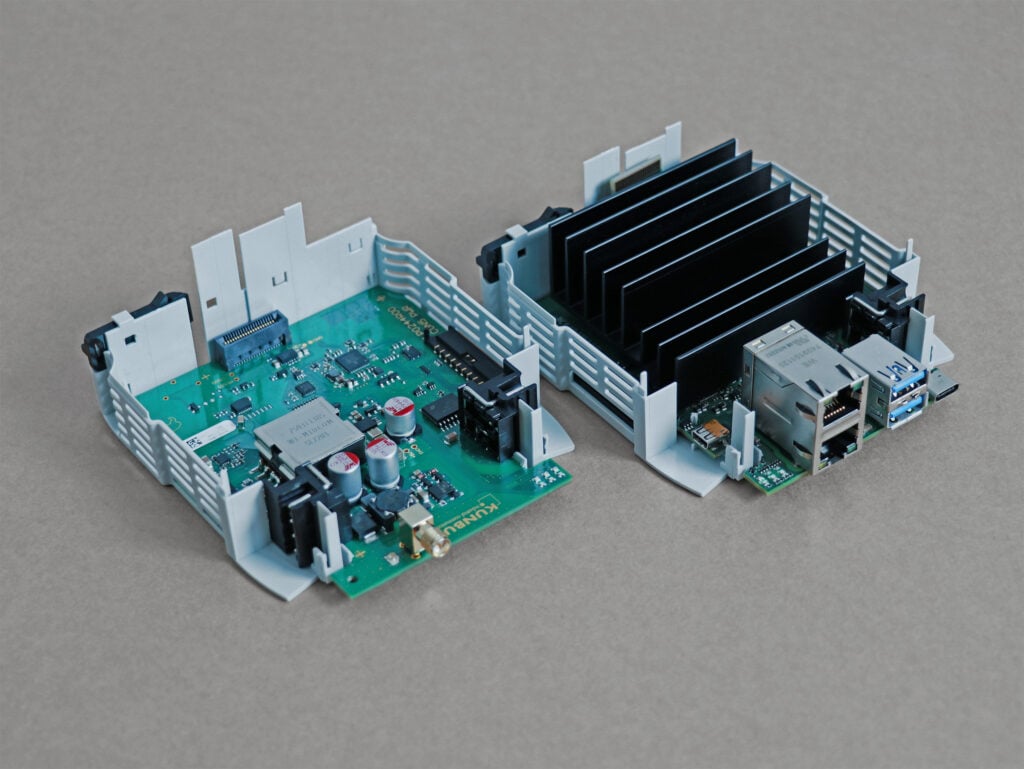
Working with Raspberry Pi on this has been exceptional. They understand what industrial developers need. We received early samples to test with, which was critical. It allowed us to iterate and optimise our design solutions, especially when developing a custom heat sink. Managing the heat generated by the powerful new Compute Module in a DIN rail enclosure was an important part of the design process. Having real hardware to test with made all the difference.
Systematic thermal management
Maintaining Compute Module 5’s operating temperature below 85°C under heavy load required a methodical development process. We started with thermal simulation analysis to identify hotspots at full operating capacity. This analysis formed the basis for our practical prototyping. Through iterative testing under extreme conditions, we optimised the heatsink design before conducting extensive testing with the final housing inside our climatic chamber. The entire process culminated in establishing precise manufacturing standards with rigorous quality control.

Seamless software integration
On the software side, working with Raspberry Pi’s platform enables smooth integration. When we hit technical challenges, their engineering team was right there to support us. Their unified kernel approach across all products allowed us to focus on integrating new features like the CAN FD interfaces instead of wrestling with compatibility issues. This standardisation benefits Revolution Pi users as well — they can use our industrialised Raspberry Pi OS-based image consistently across all Revolution Pi devices.

A proven partnership
From the first Compute Module to now, Raspberry Pi has shown growing commitment to industrial computing. Compute Module 5, purpose-built for products like Revolution Pi, demonstrates what’s possible when combining Raspberry Pi’s innovation with our industrial-grade engineering. We’re excited to continue pushing the boundaries of industrial automation and IIoT applications together.
The post Powering industrial innovation: Compute Module 5 meets Revolution Pi appeared first on Raspberry Pi.
from News - Raspberry Pi https://ift.tt/jl83uiC
Labels: IFTTT, News - Raspberry Pi

0 Comments:
Post a Comment
Subscribe to Post Comments [Atom]
<< Home