What’s new in Raspberry Pi Pico 2
At first glance, not much has changed. It’s got the same I/O… it’s using the same form factor. It looks almost the same; the biggest visual change is that the silkscreen now says ‘Pico 2’. Apart from the new RP2350 chip, we wanted everything to be as similar as possible to provide a drop-in experience for the user.

Fundamentally, it’s going to be a very similar experience to Pico, where developers will download the SDK and it will all look very, very similar in terms of building software, compiling software. Users will still plug the USB in and drag and drop their UF2 files on to it.
There are two interesting things from the circuit perspective: one is that we’ve doubled the Flash memory, so you’ve got 4MB on Pico 2 vs 2MB on the original Pico. The other is to do with the way that power is supplied to the chip.
RP2040 has an onboard linear regulator that takes 3.3V and regulates it down to 1.1V for the processor core. RP2350 has a switch-mode power supply on board, which does the same thing, but is more efficient.
One of the highlights of the RP2350 chip are the faster M33 processor cores, as opposed to the M0+. We also have RISC-V cores in there – that’s the Hazard 3 as created by Luke Wren, who’s one of our employees.
We’ve got two M33 processor cores running at 150 megahertz, so they’re roughly twice as fast as RP2040, though it will depend on your use case.
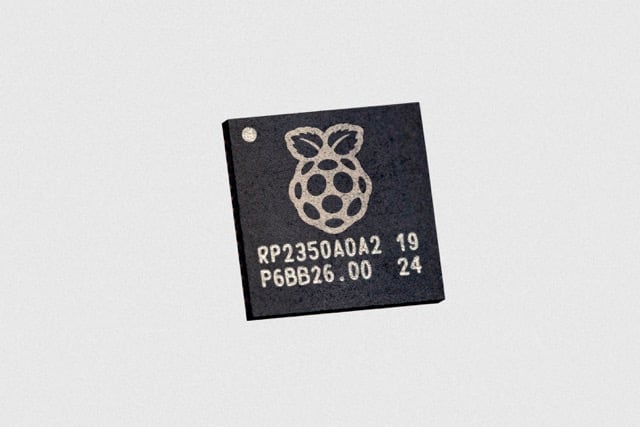
You’ve got twice as much SRAM, which is going to help with any general stuff, but especially with running things that are quite SRAM heavy, like Micropython. The PIOs have had various improvements based on what we’ve learned from RP2040, to be more efficient and allow for more use cases. And you’ve got an extra one of them in RP2350.
This is the chip we always wanted to build. RP2040 was the pathfinder to this chip. This is what we would have built as RP2040 if we’d had the capability – your second chip is always better, because you learn from the first one, and RP2350 on Pico 2 represents that. It’s faster, it’s got more peripherals. It’s got the improved power states and security that were lacking in RP2040 and the original Pico. And so we’re super pleased that we’ve now put together the chip that we always wanted to build in RP2040, but we had to cut a lot of features out because they take a long time to develop. It’s the chip we always wanted, in the Pico we always wanted.
Pico 2 hardware specification
Form factor: 21 mm × 51 mm
CPU: Dual Arm Cortex-M33 or dual RISC-V Hazard3 processors @ 150MHz
Memory: 520 KB on-chip SRAM; 4 MB on-board QSPI flash
Interfacing: 26 multi-purpose GPIO pins, including four that can be used for ADC
Peripherals: 2 × UART, 2 × SPI controllers, 2 × I2C controllers, 24 × PWM channels, 1 × USB 1.1 controller and PHY, with host and device support, 12 × PIO state machines
Input power: 1.8–5.5V DC
Operating temperature: -20°C to +85°C
The MagPi #145 out NOW!
You can grab the new issue right now from Tesco, Sainsbury’s, Asda, WHSmith, and other newsagents, including the Raspberry Pi Store in Cambridge. It’s also available at our online store which ships around the world. You can also get it via our app on Android or iOS.

You can also subscribe to the print version of The MagPi. Not only do we deliver it globally, but people who sign up to the six- or twelve-month print subscription get a FREE Raspberry Pi Pico W!
The post What’s new in Raspberry Pi Pico 2 appeared first on Raspberry Pi.
from News - Raspberry Pi https://ift.tt/8qZE3FS
Labels: IFTTT, News - Raspberry Pi

0 Comments:
Post a Comment
Subscribe to Post Comments [Atom]
<< Home