RP2350: the brains of Raspberry Pi Pico 2
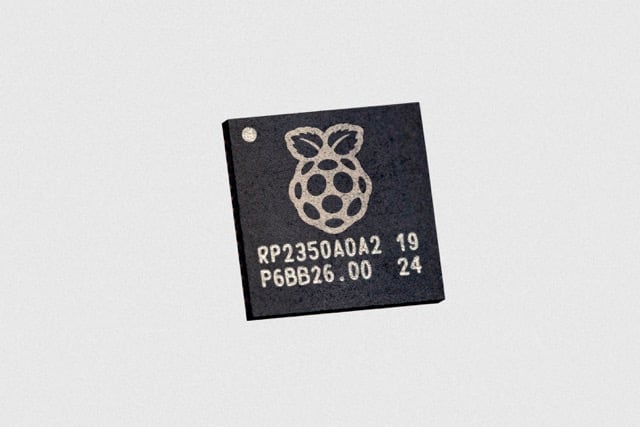
As we’ve heard from James Adams, the Pico 2 is physically virtually indistinguishable from the original Pico. What makes the difference is the brains of the board: the RP2350 chip.
There are quite a few changes from RP2040 to RP2350. The main ones are security, higher performance through dual Cortex-M33 processors running at 150MHz, more memory and new OTP, and lower power modes.
On RP2040, in our low-power state, we’d get down to about 180 microamps in our dormant state with all clocks off. On RP2350 we can switch off power to a lot of the chip and get down to less than a tenth of that, which is going to be more useful for low-power applications, for example, where a device might spend a long time just waiting for input from a sensor.
We’ve gone from a regulator to a switcher. Regulators are inherently not as efficient under load. So we’ve changed our core supply regulator – it’s actually a combination device, so it has a small regulator for low-power modes up to 1 milliamp, when most of the chip is powered down and we’re waiting to wake up. And then when we turn the core on we flip to a switch mode power supply which can provide up to 200 milliamps – more than RP2040, as the chip is bigger so has a higher peak current. The switcher is more efficient than the regulator used on RP2040.
The PIO is still there; with some enhancements to that. We now have a third PIO block in there, so another four state machines. And we’re still using the TSMC 40nm process. Re-using a process that you know saves a lot of time. When you’re going to a new process node, you have to go and get a load of new IP and have to learn how to use it all.
So sticking to the same process meant that we can reuse some of this IP and knowledge from what we did on RP2040 and also RP1 [Raspberry Pi’s first in-house chip, which was used on the Raspberry Pi 5]. So we’ve reused cell libraries, memories, ADC, PLL and USB PHY from RP2040.
So there’s quite a lot that is the same, and we can just drop it in fairly easily and can then focus on changing the other logic and adding any new IP like the OTP or core supply regulator. We did review and update parts of the existing design, but there’s an awful lot of new design in RP2350, and some higher level features like power changes or security touched a lot of the chip and has a wide impact on design and verification.
The MagPi #145 out NOW!
You can grab the new issue right now from Tesco, Sainsbury’s, Asda, WHSmith, and other newsagents, including the Raspberry Pi Store in Cambridge. It’s also available at our online store, which ships around the world. You can also get it via our app on Android or iOS.

You can also subscribe to the print version of The MagPi. Not only do we deliver it globally, but people who sign up to the six- or twelve-month print subscription get a FREE Raspberry Pi Pico W!
The post RP2350: the brains of Raspberry Pi Pico 2 appeared first on Raspberry Pi.
from News - Raspberry Pi https://ift.tt/OhpnFEw
Labels: IFTTT, News - Raspberry Pi

0 Comments:
Post a Comment
Subscribe to Post Comments [Atom]
<< Home