Certifying third-party antennas for use with Raspberry Pi Compute Modules
When designing and producing Raspberry Pi devices, we consider as many potential use cases as possible — particularly when it comes to criteria like wireless (WLAN and Bluetooth) performance and antenna usage. While our single-board computers (such as Raspberry Pi 5) include only an on-board PCB antenna, our Raspberry Pi Compute Module range offers two pre-approved options: an on-board PCB antenna and the external whip antenna from the official Raspberry Pi Antenna Kit.
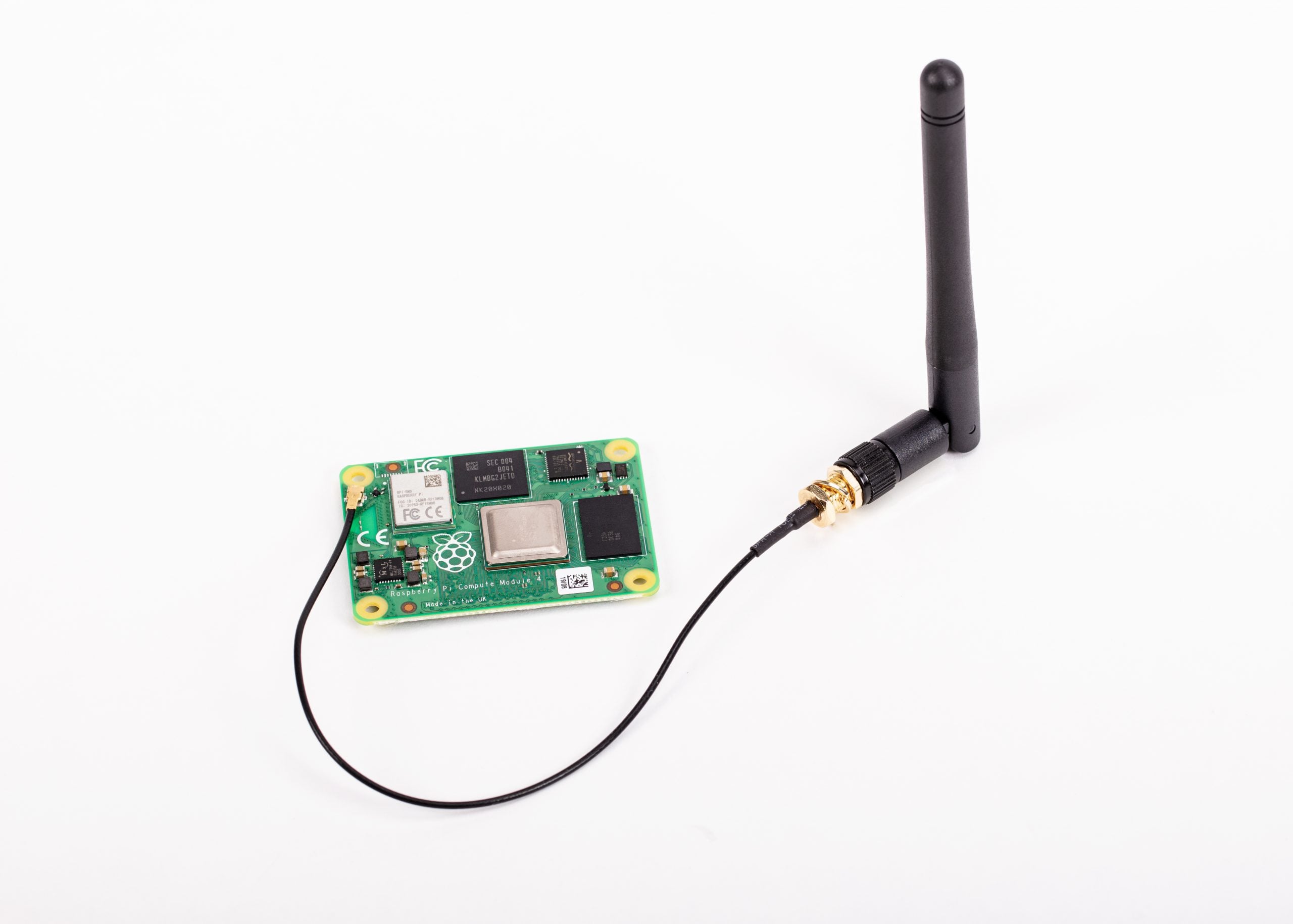
However, we recognise that some industrial and commercial customers may need to employ third-party antennas for their applications. Example scenarios include:
- Embedding a Compute Module within a metal enclosure, where the PCB antenna would perform poorly due to the Faraday cage effect
- Extending the communication distance of a device, which requires increased antenna gain
- Integrating an antenna with a different form factor, such as a flexible PCB antenna
In such cases, the Compute Module and new antenna may be required to undergo additional testing and certification before the product can be sold. While procedures vary depending on the market and the device’s features, Raspberry Pi is well placed to support our customers in meeting these additional requirements — either by updating our existing certifications or by obtaining new certifications on their behalf.
Compliance requirements
For new antennas, compliance requirements depend on whether the antenna gain is less than, equal to, or higher than the approved gain value. Alternative antenna options are therefore split into two categories:
- Antenna gain is equal to or less than the approved antenna gain
- Antenna gain is higher than the approved antenna gain
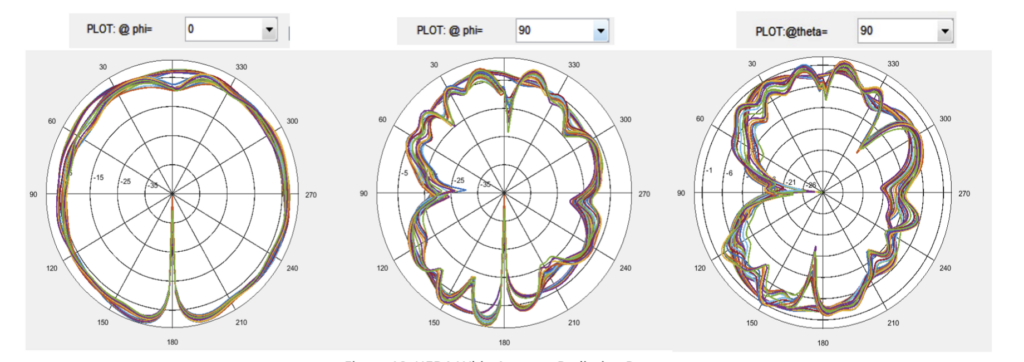
To help our commercial and industrial customers meet regulatory requirements in either gain scenario, we’ve put together a white paper outlining the certifications and testing procedures required in a number of our our key markets.
Different markets, different regulations
For example, in the UK and EU, integrators can adopt an antenna with a gain less than or equal to the gain of the antenna used for the original certification without needing to carry out any further spectrum usage testing. For antennas with higher gain, this course of action depends on how high the gain of the new antenna is, as this determines whether some or all of the spectrum usage tests need to be repeated. Integrators are, however, encouraged to carry out spurious emissions tests and other electromagnetic compatibility tests on all alternative antennas, regardless of their gain.
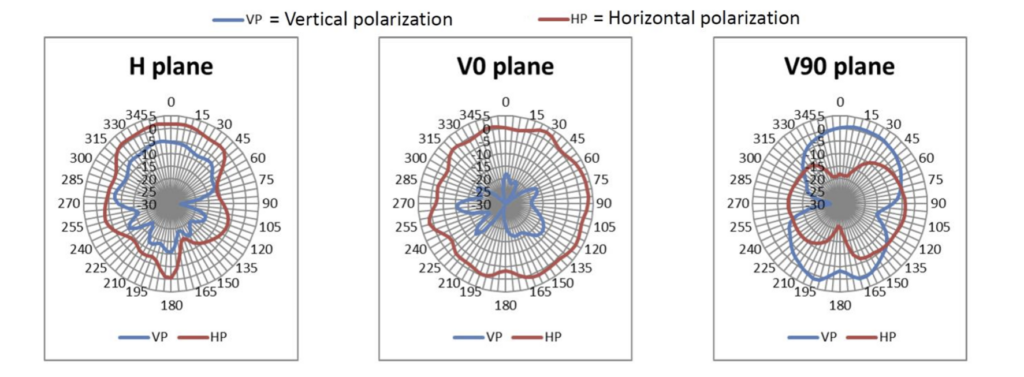
In Japan, all antennas must be approved by the country’s Ministry of Internal Affairs and Communications (MIC), and all antenna options must be listed, but no additional testing is required. Similarly, in South Korea and Taiwan, all antennas must comply with each country’s regulations — but further testing is required for antennas with higher gain. In Vietnam and Mexico, no modifications to the device’s existing certifications are required; however, manufacturers must ensure that the radiated output power of the antenna does not exceed the regulatory limits.
For a full list of requirements in several of Raspberry Pi’s key markets, refer to the handy table in our white paper.
Using pre-approved Raspberry Pi antennas
To avoid potential compliance issues or additional costs altogether, manufacturers, integrators, and end users can employ Raspberry Pi’s existing antenna architecture, which is already fully compliant in all of our key markets.
Newer Raspberry Pi single-board computers and microcontrollers include an integrated PCB Niche antenna, providing on-board Wi-Fi and Bluetooth connectivity as standard. Raspberry Pi Compute Module 4 and 5 also feature one of these PCB Niche antennas, along with a built-in U.FL connector for attaching an external antenna.
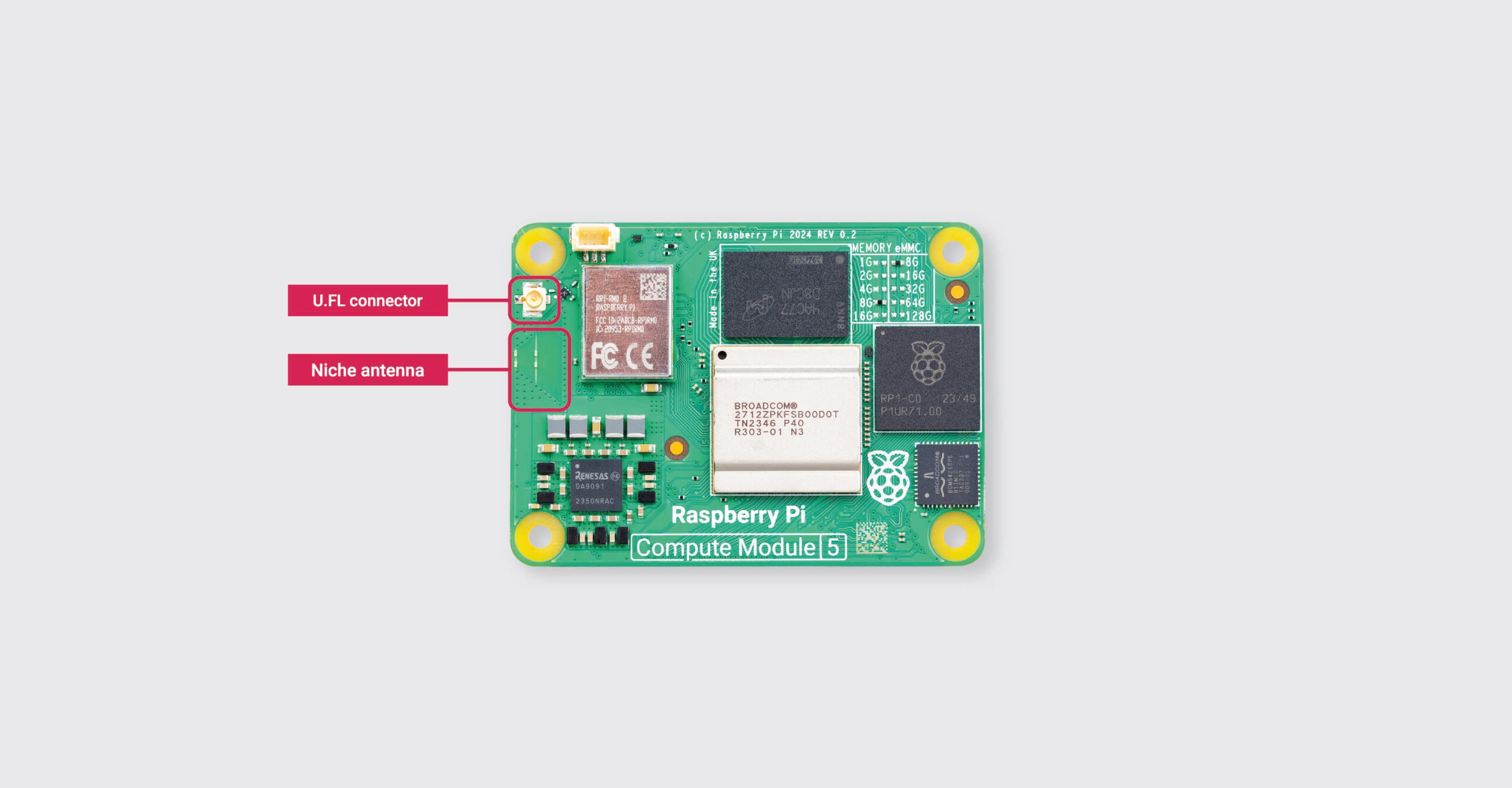
The U.FL connector on Compute Module 4 and 5 can be fitted with the omnidirectional external whip antenna included in our pre-approved Raspberry Pi Antenna Kit, or with another compatible third-party antenna.
Next steps: How Raspberry Pi can help
Should you need further assistance with integrating an alternative antenna — either during the product design process or after launch — our in-house Global Market Access (GMA) team is fully equipped to handle any additional tests, documentation submissions, or approvals on your behalf. Contact gma@raspberrypi.com with your product requirements, including the proposed antenna options and a list of your target markets (including any not listed above).
The GMA team will review your antenna specifications and advise whether compliance with the relevant market regulations is possible. Once confirmed, the team will update the existing approvals or obtain new ones to include the new antenna, carrying out any additional testing as required.
Disclaimer:
The information provided here and in our white paper is intended to be used as initial guidance only. Customers should always refer to the official regulations and publications issued by the relevant authorities.
The post Certifying third-party antennas for use with Raspberry Pi Compute Modules appeared first on Raspberry Pi.
from News - Raspberry Pi https://ift.tt/oi1LhCr
Labels: News - Raspberry Pi, IFTTT

0 Comments:
Post a Comment
Subscribe to Post Comments [Atom]
<< Home